
Cochrane helps reinterpret findings from a major trial
Doctors want the care they provide to be based on reliable research evidence. Multidisciplinary panels develop most high-quality medical guidance through systematic reviews of all relevant, reliable randomised controlled trials (RCTs). If only one large trial addresses a particular question, some people question whether a systematic review is really needed, since the panel can use that one trial as evidence.
This story shows that, even in these circumstances, conducting a systematic review is worthwhile. The critical appraisal process can shed new light on the trial data, and panels may want evidence presented differently, which can lead to adjustments in the analysis and reinterpretation.
Science is also about relationships. Here we see the power of collaboration, and how generosity of spirit advances science.
The original Cochrane review
The story starts with Professor Bongani Mayosi, an amazing clinician and researcher (1967-2018).
Bongani was an influential cardiologist and clinical scientist who worked in heart and infectious diseases in South Africa. Our Cochrane Infectious Diseases Group (CIDG) team in Liverpool worked with him for almost 20 years. In 2002, he published a Cochrane review with us summarising the effects of corticosteroids in people with tuberculosis (TB) pericarditis, based on all available RCTs. In this single-author review, he identified two small trials (total 383 participants) conducted before HIV had emerged, and a third trial of 58 people who were HIV-positive.1
The Investigation of the Management of Pericarditis (IMPI) trial
Given the limited evidence, Bongani applied for a grant from the Canadian Institutes of Health Research. He received funding and carried out a large, multi-country trial on the topic.
The trial included people with tuberculous pericarditis and tested the effects of corticosteroids. The trial also tested another immunosuppressant product: Mycobacterium indicus pranii, a non-pathogenic bacterial species, marketed as a medicinal product in India.
The trial used a factorial design (see explanatory box). One group was randomised to placebo, one to corticosteroids (prednisolone), one to M. indicus pranii, and one to both corticosteroids and M. indicus pranii. The trial design meant that, in the absence of an interaction between the interventions, the whole trial population could contribute to the estimate of the effect of corticosteroids and to the estimate of the effect for M. indicus pranii.
Explanatory box: factorial design in a RCT
A factorial design is an efficient clinical trial format that tests two or more interventions simultaneously using the same group of participants. For example, in a two-intervention study, participants are split into four groups:
- Group 1 receives neither intervention (the control),
- Group 2 receives Intervention A only,
- Group 3 receives Intervention B only,
- and Group 4 receives both A and B.
To evaluate Intervention A, researchers pool and compare all participants who received it (Groups 2 and 4) against those who did not (Groups 1 and 3). Researchers evaluate Intervention B the same way. This efficient approach assumes that Intervention B does not alter the effect of Intervention A. If the interventions do influence each other, this creates an interaction effect, meaning the combined analysis must be abandoned and each treatment arm must be analysed separately
The trial authors tested for interaction (see explanatory box) between the effects of M. indicus pranii and prednisolone. They noted that 9 of the 13 cases of cancer occurred in the prednisolone group who also received M. indicus pranii. They used statistical tests to assess whether this was chance or likely a true effect, but the test did not demonstrate an interaction. The authors state, “Although a clinical interaction between the two interventions on cancer cannot be ruled out, the number of cases is small”.
The trial results were published in the New England Journal of Medicine (NEJM) in 2014. This text is from the results in the abstract:2
“There was no significant difference in the primary outcome” (a composite of death, cardiac tamponade requiring pericardiocentesis, or constrictive pericarditis) “between patients who received prednisolone and those who received placebo… Both prednisolone and M. indicus pranii, each as compared with placebo, were associated with a significant increase in the incidence of cancer.“
The NEJM paper concluded:
“In patients with tuberculous pericarditis, neither prednisolone nor M. indicus pranii had a significant effect on the composite of death, cardiac tamponade requiring pericardiocentesis, or constrictive pericarditis.”
We spoke with Bongani about updating the 2002 Cochrane review in June 2014 when the trial was published. We agreed that his study dwarfed the data from the three small trials in the review and that updating the Cochrane review was not a priority, as this large trial didn’t show benefit and guideline panels could use it to guide policy.
India National Extra-pulmonary TB Guidelines Panel
In October 2024, Professor Surendra K Sharma from the All India Institute of Medical Sciences, working with the National TB Institutes of India, the Central TB Division of the Ministry of Health and Family Welfare, Government of India, set up a Guideline Panel called INDEX-TB (an acronym for Indian Extra-Pulmonary Tuberculosis).3
This group asked the CIDG team to provide “valuable guidance to this endeavour” in using GRADE, an internationally recognised standard for guideline development that we were experienced in. One question they asked was when to use corticosteroids for TB meningitis, TB pleura, and TB pericarditis.
The India INDEX-TB Guidelines Panel needed an updated systematic review of the original 2002 Cochrane review, including Bongani’s IMPI trial, with a summary-of-findings table. This table uses a set, specific format using GRADE methods and presents the review results on a single page. Bongani kindly found time to put the IMPI trial results into a draft update of the original Cochrane review.
The draft Cochrane review was shared with the India INDEX-TB Guidelines Panel. The Panel noted that 67% of the patients in the IMPI trial were HIV-positive. As HIV was much less common in India, they requested the results be stratified by HIV status before making a recommendation. That is, to look at the effect of the intervention in persons who are HIV-positive and those who are HIV-negative. This seemed reasonable, as the effect could differ substantially in immunocompetent individuals, but required the trial authors to re-analyse the data.
Revision of the Cochrane review stratified by HIV status
Bongani and his author team returned to the data and conducted this analysis, preserving the factorial design; they then submitted this draft Cochrane review update for editorial approval and peer review.
A peer reviewer at the CIDG, Dr Maya Tickell-Painter, noted that the draft Cochrane review concluded that corticosteroids increased cancer deaths in HIV-positive patients. This did not align with the peer reviewer’s expectations, so we revisited the 2014 NEJM paper. We extracted the following death data from one of the graphs for all-cause cancer in all patients irrespective of HIV status.
- Eleven in the prednisolone + M. indicus pranii group (11/316)
- Two in prednisolone alone group (2/315)
- One in M. indicus pranii alone group (1/319)
- One in placebo group (1/310)
When patients took the two drugs together (prednisolone + M. indicus pranii), they influenced each other’s effects in a harmful way. Instead of helping, the drug combination caused a spike in patient deaths.
If you look at the raw study numbers or a chart, this jump in deaths is obvious. However, because the study was too small, standard statistical testing couldn’t officially prove that the deaths were caused by the drugs rather than just a random coincidence. Despite that mathematical limitation, researchers later conducted follow-up research and discovered the exact biological reason these specific drugs cause harm in the body (an interaction).4
In these circumstances, the only proper analysis is to abandon the factorial design and analyse each arm separately. The CIDG editorial group insisted that the Cochrane review present the trial data as single arms. The Cochrane review author team regretted the loss of statistical power (because people receiving both drugs were excluded from the analysis) but accepted the editorial advice for the review revision.
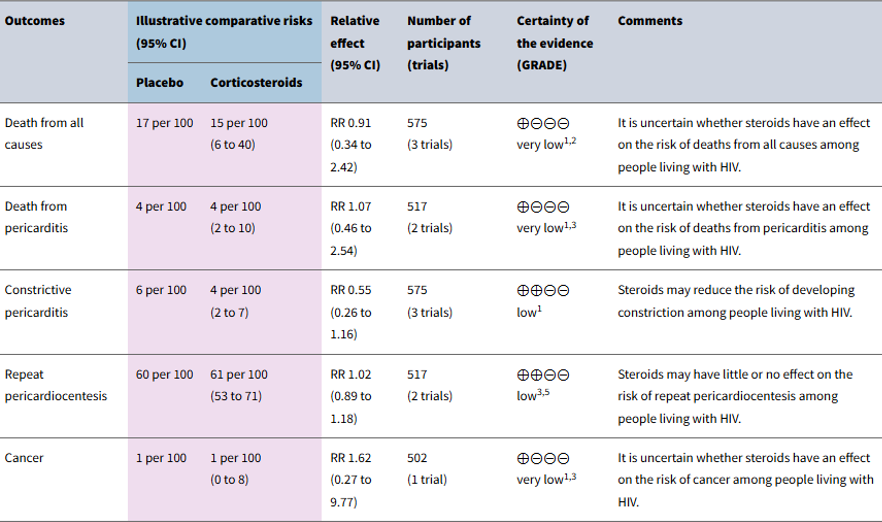
Thus, the revised analysis excluded all patients receiving both corticosteroids and M. indicus pranii, separated the patients into those with and those without HIV infection, and also included patients from the smaller trials. Tables 1 & 2 summarise the analyses, along with an extract from the Cochrane review abstract below.
Table 1. Summary of findings. Corticosteroids for tuberculous pericarditis in HIV-negative people — from Wiysonge et al. 20175
Population: HIV-negative people with tuberculous pericarditis
Setting: any setting
Intervention: corticosteroids
Comparison: placebo
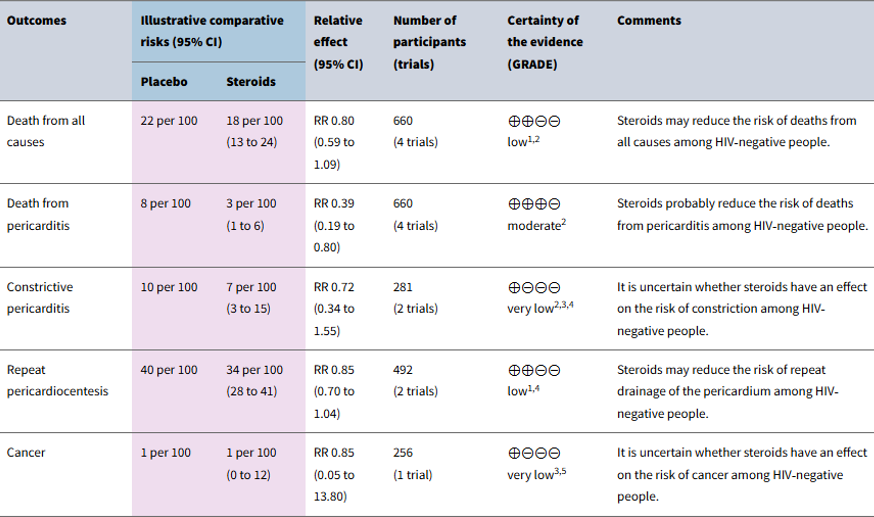
Table 2. Summary of findings. Corticosteroids for tuberculous pericarditis in HIV-positive people — from Wiysonge et al. 20175
Population: HIV-positive people with tuberculous pericarditis. Most (80%) not on antiretroviral drugs
Settings: any setting
Intervention: corticosteroids
Comparison: placebo
From the results section of the Cochrane abstract:5
In people who are not infected with HIV, corticosteroids may reduce deaths from all causes (risk ratio (RR) 0.80, 95% confidence interval (CI) 0.59 to 1.09; 660 participants, 4 trials, low certainty evidence) and the need for repeat pericardiocentesis (RR 0.85, 95% CI 0.70 to 1.04; 492 participants, 2 trials, low certainty evidence). Corticosteroids probably reduce deaths from pericarditis (RR 0.39, 95% CI 0.19 to 0.80; 660 participants, 4 trials, moderate certainty evidence). However, we do not know whether or not corticosteroids have an effect on constriction or cancer among HIV‐negative people (very low certainty evidence).
In people living with HIV, only 19.9% (203/1959) were on antiretroviral drugs. Corticosteroids may reduce constriction (RR 0.55, 0.26 to 1.16; 575 participants, 3 trials, low certainty evidence). It is uncertain whether corticosteroids have an effect on all‐cause death or cancer (very low certainty evidence); and may have little or no effect on repeat pericardiocentesis (RR 1.02, 0.89 to 1.18; 517 participants, 2 trials, low certainty evidence).
The Cochrane review authors conclude:
For HIV‐negative patients, corticosteroids may reduce death.
For HIV‐positive patients not on antiretroviral drugs, corticosteroids may reduce constriction.
For HIV‐positive patients with good antiretroviral drug viral suppression, clinicians may consider the results from HIV‐negative patients more relevant.
This analysis therefore concludes that corticosteroids are of benefit in people who are HIV-negative. We also may surmise they are effective in people who are HIV-positive and on antiretroviral drugs.
This effectively reverses the inferences made in the 2014 NEJM paper of no effect and provides a much clearer policy steer. We appreciate that the other small trials contributed to the overall meta-analysis, but the reversal of the NEJM conclusion largely resulted from excluding the IMPI trial arm, with the large number of deaths resulting from an interaction between the two interventions.
A rapid appraisal of global guidelines on tuberculosis suggests that not all use the 2017 Cochrane review version.5
For example, the American Thoracic Society (ATS), Centers for Disease Control and Prevention (CDC), and Infectious Diseases Society of America (IDSA) Guideline from 2016 states that “adjunctive corticosteroids should not be used routinely in the treatment of patients with pericardial tuberculosis….”.6
National and global technical guideline groups should appraise their current recommendations in light of the more reliable results in the 2017 Cochrane review. The certainty of the evidence they present or the recommendations they make may need updating.
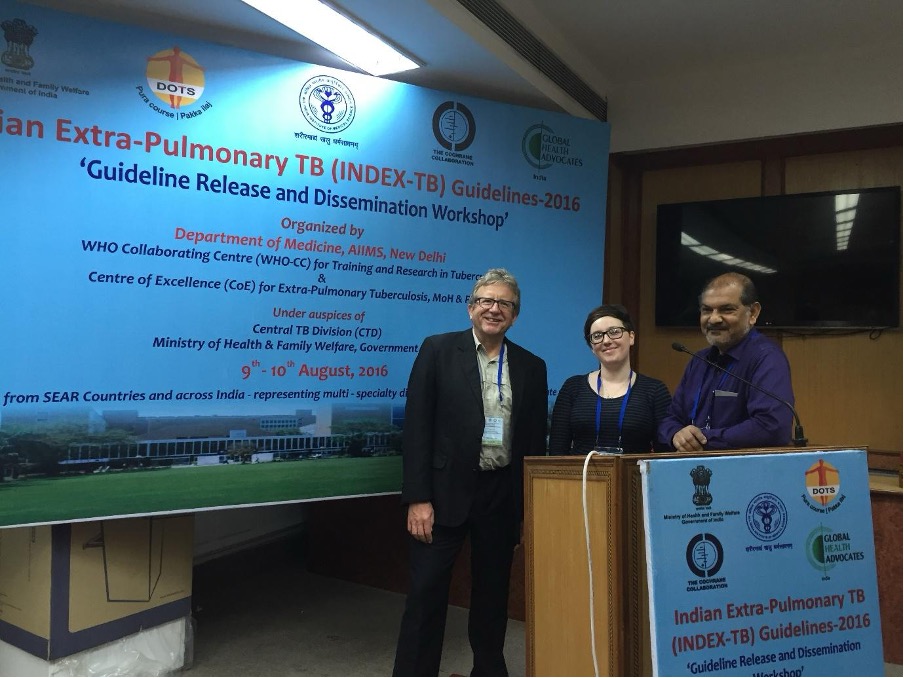
(Professor Paul Garner and Dr Hannah Ryan, CIDG; and Professor Prathap Tharyan, Director of the SE Asia Cochrane Centre)
Conclusions
This interesting case study emphasises the following.
- We know that an interaction between two interventions can occur in a factorial-designed trial, but the absence of a “statistically significant difference” does not demonstrate there is no interaction. It may simply mean the numbers are too small to show the interaction statistically.
- Independent evidence synthesis is a vital prerequisite to guideline development, even if a single large trial seems to demonstrate clearly what guideline panels should do.
- The value in guideline panels identifying the questions they want to address, and that the systematic review addresses these questions directly.
We know that collaboration between researchers and decision-makers helps research uptake and ensures research relevance7. Here, the questions they raised not only made the results more relevant, but the re-analysis also changed the research message.
The INDEX-TB Guidelines Panel recommended corticosteroids be used for people who are HIV-positive and people who are HIV-negative.3,8,9 If the Panel had used the 2014 NEJM trial report alone, it is unlikely they would have recommended corticosteroids.
When an effective intervention is omitted, this is the equivalent of doing harm, so we recommend Guideline Panels use the updated Cochrane review5 rather than the 2014 NEJM paper2 in forming guidance for patients.
Postscript
We pay homage to Bongani Mayosi for his distinguished research career.
We valued his energy, integrity, and humble scientific openness, particularly in re-analysing and reinterpreting his own trial. He was a most endearing, inspiring person to work with, and many people are saddened by his untimely death.10
A recent memorial lecture in tribute to Professor Mayosi described his legacy as “… a profound testament to a life lived with steady integrity, exceptional kindness, scientific excellence and unwavering compassion, reminding us to embrace generosity, intention, mentorship and humility in how we live our own lives in service to others“.11
Acknowledgements
Thanks to Professors Jimmy Volmink and Lehana Thabane for feedback, and Professor Nonhlanhla Khumalo for permission to use the portrait.
References
Index-TB guidelines
Guidelines on extrapulmonary tuberculosis for India
Index-TB guidelines
Evidence Summaries and Guideline Panel Decision Tables – Core Group Guideline Meeting
- Mayosi BM. Interventions for treating tuberculous pericarditis. Cochrane Database of Systematic Reviews 2002, Issue 4. Art. No.: CD000526. DOI: 10.1002/14651858.CD000526 [↩]
- Mayosi BM, Ntsekhe M, Bosch J, Pandie S, Jung H, Gumedze F, et al. Prednisolone and Mycobacterium indicus pranii in tuberculous pericarditis. New England Journal of Medicine. 2014;371(12):1121-30. DOI: 10.1056/NEJMoa1407380 [↩] [↩]
- Sharma SK, Ryan H, Khaparde S, Sachdeva KS, Singh AD, Mohan A, et al. Index-TB guidelines: Guidelines on extrapulmonary tuberculosis for India. Indian Journal of Medical Research. 2017;145(4):448-63. DOI: 10.4103/ijmr.IJMR_1950_16 [↩] [↩]
- Steigler P, Chhiba M, Francis V, Keyser A, Abrahams D, Hanekom W, et al. T cell responses to Mycobacterium indicus pranii immunotherapy and adjunctive glucocorticoid therapy in tuberculous pericarditis. Vaccine: X. 2022;11:100177. DOI: 10.1016/j.jvacx.2022.100177 [↩]
- Wiysonge CS, Ntsekhe M, Thabane L, Volmink J, Majombozi D, Gumedze F, et al. Interventions for treating tuberculous pericarditis. Cochrane Database of Systematic Reviews 2017, Issue 9. Art. No.: CD000526. DOI: 10.1002/14651858.CD000526.pub2 [↩] [↩] [↩] [↩] [↩]
- Nahid P, Dorman SE, Alipanah N, Barry PM, Brozek JL, Cattamanchi A, et al. Official American Thoracic Society/Centers for Disease Control and Prevention/Infectious Diseases Society of America Clinical Practice Guidelines: Treatment of Drug-Susceptible Tuberculosis. Clinical Infectious Diseases 2016;63(7):e147-95. DOI: 10.1093/cid/ciw376 [↩]
- Lomas J. Using ‘linkage and exchange’ to move research into policy at a Canadian foundation. Health Affairs (Millwood). 2000;19(3):236-40. DOI: 10.1377/hlthaff.19.3.236 [↩]
- World Health Organization. Country Office for India (2016). Index-TB guidelines: guidelines on extra-pulmonary tuberculosis in India. World Health Organization. County Office for India. https://iris.who.int/handle/10665/278953 [↩]
- INDEX-TB Guidelines. Evidence summaries and guideline panel decision tables: core group guideline meeting 14-18 June 2025. 2016.10. Mensah GA. In Memoriam. Journal of the American College of Cardiology. 2018;72(21):2671-3. DOI: 10.1016/j.jacc.2018.10.009 [↩]
- Ntusi N. Professor Bongani Mayosi: a legend in our time. South African Medical Journal 2018; 108(9): 695-6. DOI: 10.7196/samj.2018.v108i9.13584 [↩]
- Thabane L. The 6th UCT Bongani Mayosi Memorial Lecture: Fostering evidence-based humanity in the academy and beyond: Lessons from the legacy of Prof. Bongani Mayosi. South African Medical Journal. 2026;116(4):e4844. DOI: 10.7196/SAMJ.2026.v116i4.4844 [↩]